For craft fairs and vendor markets
Know if the booth fee can pay back before you book.
Market Math turns your booth fee, traffic estimate, product costs, card fees, conversion rate, and inventory into a clear break-even target and a GO, BORDERLINE, or PASS decision.
One-time purchase. Verified 10-sheet XLSX kit. Instant Etsy download.

Try the decision first
What must this market sell to break even?
Use the organizer's attendance estimate and your own product economics. Nothing entered here leaves your browser.
Event assumptions
Your forecast
Estimate only. The full workbook adds product-level inventory capacity, target profit, safety margin, actual logs, and a forecast-versus-actual scorecard.
The Etsy download adds product mix, inventory capacity, target profit, preparation, sales and expense logs, and a forecast-versus-actual scorecard.
Get the 10-sheet kit on Etsy - $12The missing decision
Most vendor planners begin after you already paid.
Market Math begins with the booking decision, then carries the same assumptions into inventory, preparation, sales, expenses, and the post-event review.
Price the full event
Include booth, travel, parking, lodging, permits, paid help, display allocation, processor fees, and product cost.
Cap sales by inventory
The workbook uses the lower of forecast demand and the sales value of everything you can actually bring.
Learn from the result
Compare forecast with actual sales, orders, expenses, product cost, profit, and profit per working hour.
Inside the workbook
Built for the full market cycle.
Decide and prepare
- Event Decision with GO / BORDERLINE / PASS
- Product Mix with inventory sales capacity
- Break-even sales and break-even buyers
- Profit target and safety-margin check
- Inventory Plan and Event Calendar
- 20-item Packing Checklist
Track and improve
- 50-order Sales Log
- 40-row Expense Log
- Forecast-versus-actual Event Scorecard
- Profit per work hour
- Post-event learning questions
- Source and assumption notes
Formula-driven, not decorative
Every important answer traces back to an editable assumption.
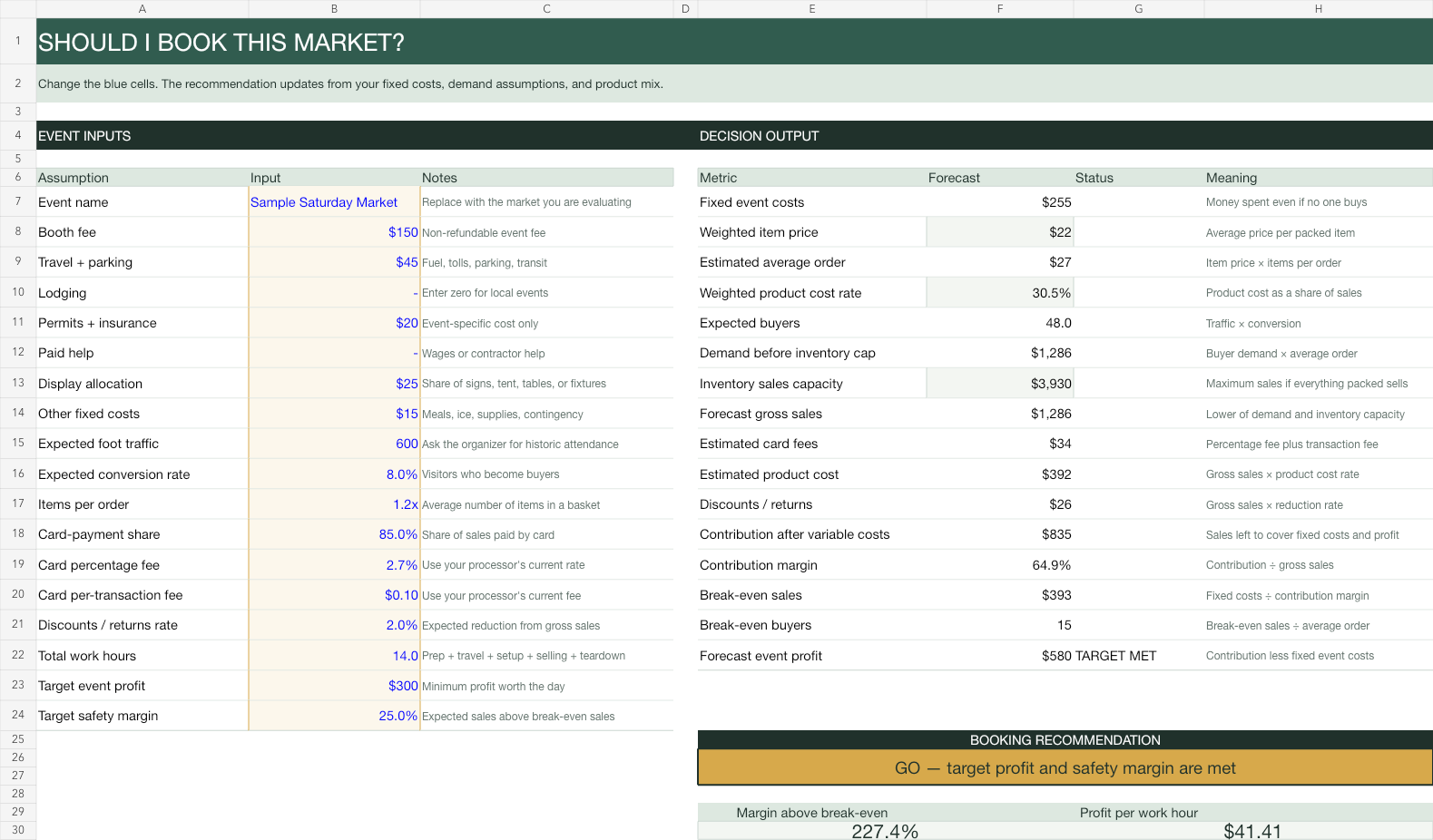
Test the event before paying.
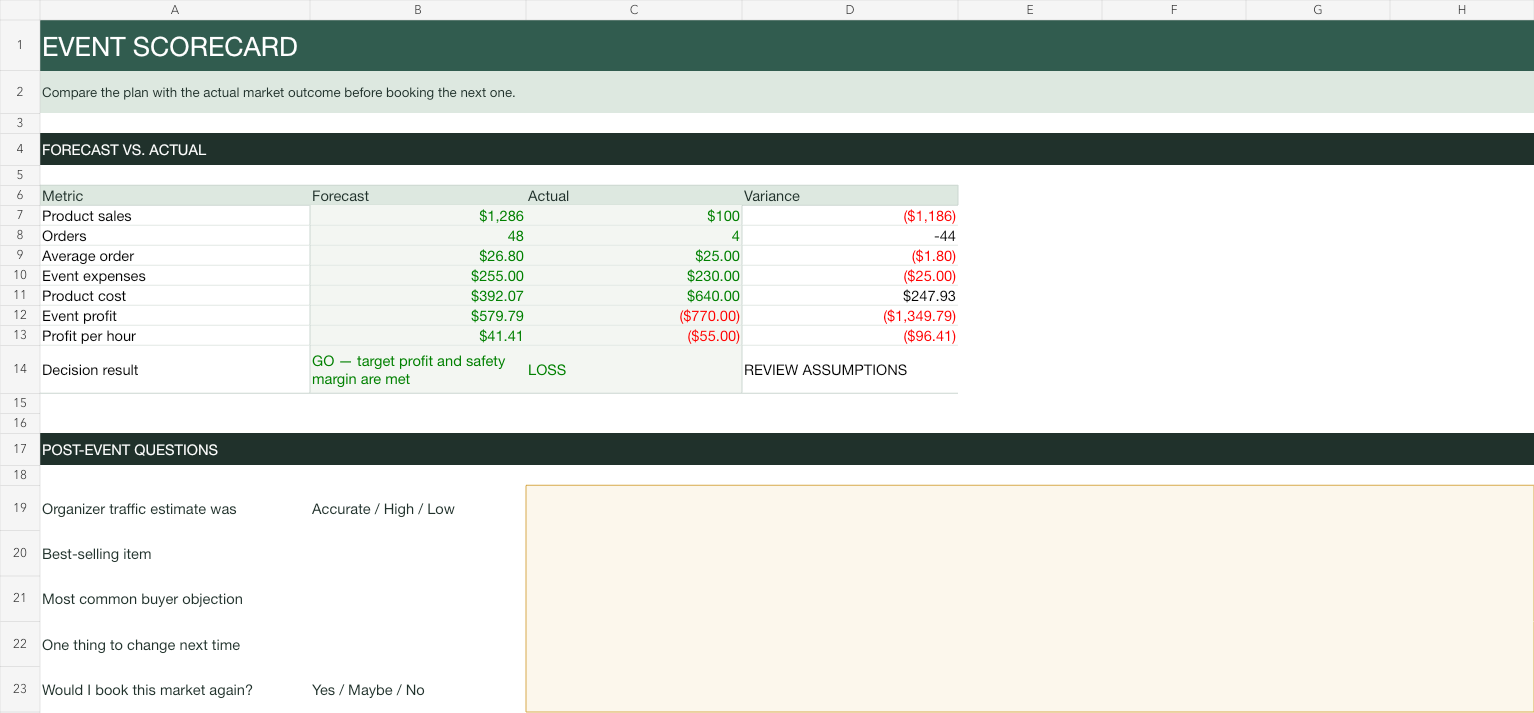
Measure what really happened.
Make the booth fee earn its place.
Get the same verified 10-sheet Excel workbook with the product mix, inventory cap, target-profit check, preparation tools, logs, and scorecard. Choose Etsy for familiar marketplace checkout or buy directly.
Save it for application day
Keep the booking question in sight.
Use these reminders when the next market application arrives.
Questions
Plain answers.
Does this guarantee an event will be profitable?
No. It creates a planning estimate from the assumptions you enter. Attendance, weather, buyer behavior, organizer execution, product-market fit, and other conditions can change the result.
Where does the break-even formula come from?
The method follows the U.S. Small Business Administration's break-even framework: fixed costs divided by contribution margin for break-even sales, or fixed costs divided by price less variable cost for units.
What software do I need?
The XLSX workbook is designed for Microsoft Excel and compatible spreadsheet applications. It contains no macros or external data connections.
Can I reuse it?
Yes. One buyer or one small business may make copies for its own events. The workbook may not be resold, redistributed, or published as a template.
Is this accounting or tax advice?
No. It is a planning tool. Use your own records and qualified advisers for accounting, tax, legal, insurance, and event-contract decisions.
Method source: U.S. Small Business Administration break-even guidance. Product prices, processor fees, and event assumptions are always user inputs.